Most people never think about municipal solid waste laws. They don’t show up on a ballot. They aren’t explained when you pull a permit. And they usually don’t matter—until a dumpster is impounded, a job site is shut down, or a contractor is forced to use a single overpriced provider with no alternatives.
This article breaks down what exclusive municipal solid waste franchise agreements in Texas actually are, where they came from, how they’re enforced today, and why they’ve become one of the biggest hidden threats to competition in construction, development, and property ownership across the state.
This is not about weekly residential trash pickup.
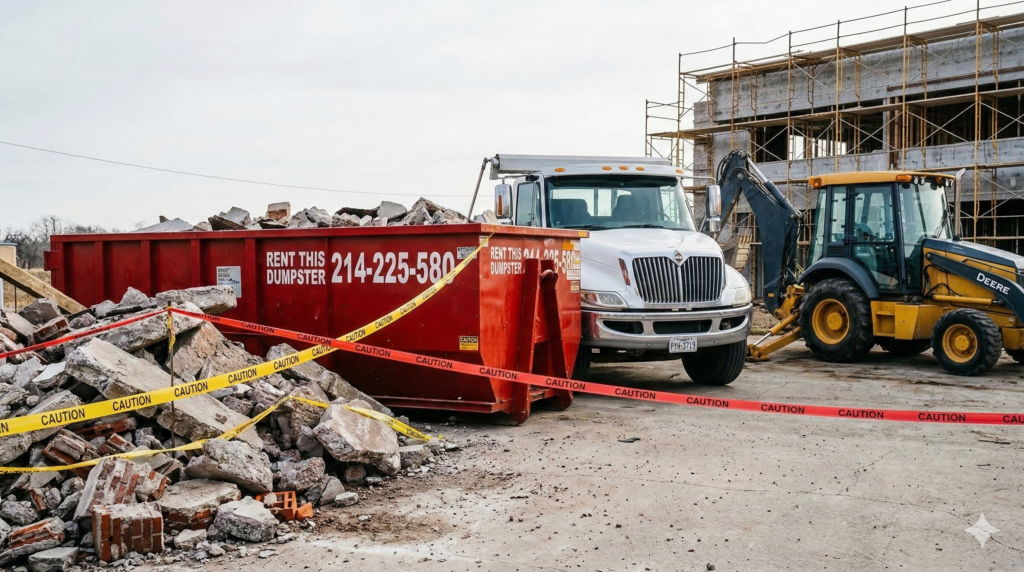
This is about roll-off dumpsters, temporary containers, construction debris, remodels, demolitions, cleanouts, and job-site waste—and how cities are using government power to control who can operate in those markets.
Throughout this article, FACT and OPINION will be clearly labeled.
What Exclusive Solid Waste Franchise Agreements Were Originally Meant to Do
FACT:
Exclusive solid waste franchise agreements were originally created for one primary reason: public health.
Decades ago, cities needed to ensure household trash was collected safely and consistently. Without regulation, neighborhoods could end up with multiple haulers running uncontrolled routes, illegal dumping, inconsistent service, and public health hazards.
To solve this, cities awarded exclusive residential trash contracts:
- One provider
- Set routes
- Set schedules
- Regulated service
For weekly curbside residential trash, this system made sense.
Where Things Went Wrong: Expanding “Solid Waste” Beyond Its Purpose
FACT:
Roll-off dumpster service is fundamentally different from residential trash collection.
Rolloff dumpsters are:
- Temporary
- Job-specific
- Non-route-based
- Used for construction, demolition, remodeling, and cleanouts
They do not operate on weekly schedules or fixed routes and do not present the same public-health concerns as household garbage.
OPINION:
Cities realized that if they defined “solid waste” broadly enough, they could lump roll-off dumpsters into residential waste regulation—and once they did that, they gained total control over an entirely separate market.
This is where exclusivity stopped being about sanitation and started becoming about market control and revenue generation.
How Cities Actually Enforce These Monopolies
FACT:
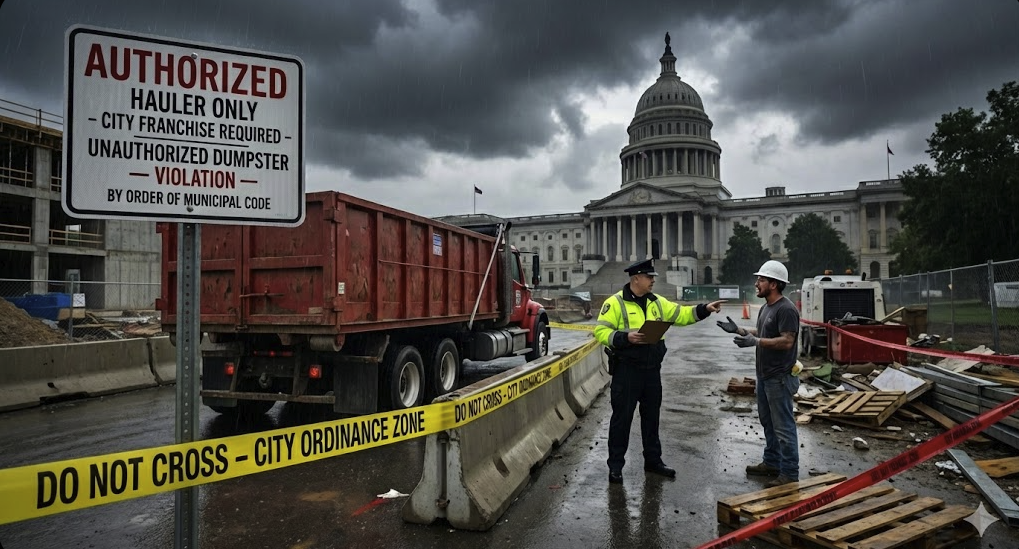
Most city ordinances do not explicitly say, “You may not use another dumpster company.”
Instead, they use indirect language such as:
- “Only the franchise holder may collect solid waste”
- “Unauthorized waste collection is prohibited”
- “Use of non-franchise haulers is a violation”
Then they redefine “solid waste” to include roll-off dumpsters.
OPINION:
This is regulatory sleight of hand. The outcome is the same as an outright ban, but the wording is designed to survive legal scrutiny.
What Enforcement Looks Like in the Real World
This is not theoretical. These are real examples.
Mesquite
FACT:
Mesquite operates its own dumpster service. When independent haulers placed dumpsters within city limits, the city:
- Impounded the containers
- Charged impound fees
- Issued citations to drivers when picking up containers, not placing them
The dumpster was already on site. The customer already rented it. The city still penalized the hauler.
OPINION:
That is not regulation. That is intimidation.
Midlothian
FACT:
Midlothian has used stop-work orders on construction sites when contractors refused to remove independent dumpsters and switch to the city’s franchise provider.
Permits were frozen. Work stopped.
Not for safety.
Not for code violations.
But solely because of which dumpster company was used.
OPINION:
This is government power being used to force private commerce into a monopoly.
Hurst
FACT:
A city inspector physically prevented a driver from performing a swap on an active job site and ordered existing dumpsters removed immediately—without citation or warning.
OPINION:
That is active market control, not enforcement.
Waxahachie
FACT:
Waxahachie’s ordinance does not directly ban non-franchise dumpsters. Instead, it shifts enforcement pressure onto homeowners, threatening them with compliance actions unless they use the franchise provider.
Same outcome. Different tactic.
OPINION:
This is ordinance drafting designed to achieve monopoly results while dodging legal challenges.
The Legal Background Cities Don’t Like to Talk About
FACT:
There was a major Texas case involving TDS and Republic Services that initially ruled cities were overreaching by applying exclusive franchises to roll-off dumpsters.
That ruling recognized:
- Rolloff service is different from residential trash
- Cities exceeded their intended authority
FACT:
That ruling was later overturned on appeal.
OPINION:
The reversal became a blueprint. Cities across Texas studied it and rewrote their ordinances to tighten enforcement while technically complying with state law.
This is not accidental. It is coordinated adaptation.
Franchise Fees: The Hidden Tax Nobody Voted For
FACT:
Exclusive franchise agreements include a franchise fee, typically ranging from 5% to 15% of gross revenue paid by the hauler to the city.
Cities claim this is for:
- Right-of-way use
- Cost recovery
- Infrastructure
FACT:
No hauler absorbs this cost. It is mathematically impossible.
That fee is baked directly into pricing.
OPINION:
Franchise fees function as a hidden tax:
- Not voted on
- Not itemized
- Paid by contractors, developers, property owners, and renters
Most cities deposit franchise fees into their general fund, not road repair accounts.
What Happens When Competition Is Eliminated
FACT:
When there is only one authorized provider:
- Prices increase
- Service slows
- Flexibility disappears
Emergency swaps cost more. Dumpsters sit full for weeks. Job schedules slip.
FACT:
Delays cause:
- Lost labor hours
- Missed inspections
- Missed deadlines
- Liquidated damages
Those costs are passed on to:
- Developers
- Businesses
- Homeowners
- Renters
OPINION:
Cities claim they’re protecting the public. In reality, they’re protecting guaranteed revenue streams.
HB 1227: What the Bill Actually Did
FACT:
House Bill 1227, introduced by Texas State Rep. Gary Gates in 2025, was narrowly targeted.
It did not:
- Eliminate residential trash franchises
- Remove city authority
- Deregulate waste
It did two specific things:
1. Franchise Fee Cap
Capped municipal franchise fees at 2% of gross receipts, instead of 5–15%.
Cities could still regulate. They just couldn’t abuse the system.
2. Freedom of Choice for Non-Residential Customers
Prohibited cities from forcing contractors, developers, apartment complexes, and commercial properties to use a single hauler.
Residential weekly trash was untouched.
FACT:
HB 1227 passed committee and reached the House calendar but never received a Senate hearing before the session ended.
It did not fail on policy. Time ran out.
Why 2027 Matters
FACT:
Once a bill reaches the calendar, precedent is set. Stakeholders are identified. Arguments are documented.
OPINION:
If HB 1227 is reintroduced in 2027 with:
- Hauler documentation
- Contractor testimony
- Property owner support
It becomes much harder to quietly kill.
This is not about special treatment.
This is about restoring balance.
The Bottom Line
This isn’t really about dumpsters.
It’s about whether cities can:
- Decide winners and losers in private markets
- Enforce monopolies through ordinances
- Take a cut of private commerce without voter approval
If cities can do this to waste hauling, they can do it to any trade.
And when competition disappears, everyone pays.